How two VPN servers became a software project
One weakness of my original setup I used in the summer of 2025 was that I didn't have a convenient way to add new VPN clients to my WireGuard server back in Oregon. With ZeroTier, this could now be done, however I'd have to always do it on both my primary VPN (the Beelink mini PC at my house) and the secondary VPN (the original Raspberry Pi at my brother's house). I wanted a more convenient way to handle this, and to be able to have some basic monitoring of the system, thus was born Aldur!
I started this project on July 2, 2026, calling it "The Vale", thinking it'd just be a convenient interface and monitoring for a couple of VPN clients. I really didn't have any intention to run a bunch of services on it or anything. Over time it would grow though, in fact I'm writing these blog articles on a custom service I'm hosting on it (spoiler alert)!
Where “The Vale” and the names came from
Before we get into just what exactly Aldur does, let's talk about why this whole project is called "The Vale", and where does Aldur come from? Well, one of my favorite book series of all time is the fantasy series, "The Belgariad", by David Eddings! In it there's a place called "The Vale" where the god Aldur lives. It's a beautiful, peaceful place where Aldur and his disciples live, his disciples are all sorcerers. The main disciple, who has also been tasked with keeping much of the world running properly, is named Belgarath, and then another powerful disciple is Beldin. They call themselves a brotherhood, later on Durnik joins them as a brother sorcerer.
So I decided to call my whole project "The Vale" and then name all the services and components after characters or other things from the book series. Aldur is the control panel for all the services.
What Aldur actually does
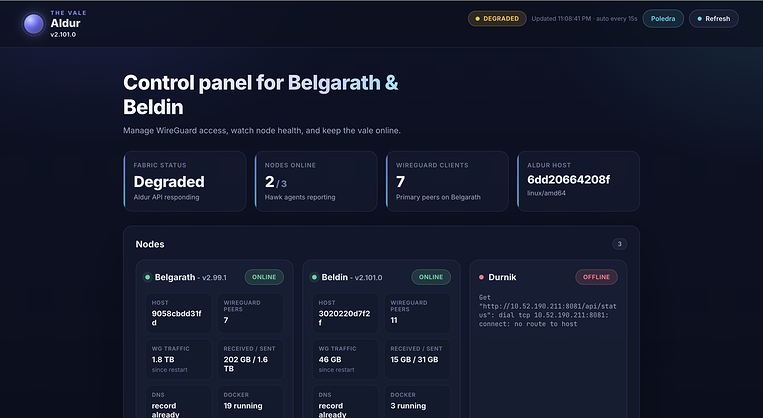
Aldur has some basic monitoring over the different "nodes" in my system. The first two nodes were Belgarath (the Beelink mini PC) and Beldin (the original Raspberry Pi). It tells me if they're online, and some data about their DNS records and WireGuard traffic.
In addition, there is an interface where I can add new WireGuard clients and they get added to both VPN servers at the same time! I am then given the option to download the configuration files or scan the QR codes for them from a device to get the configuration onto a client.
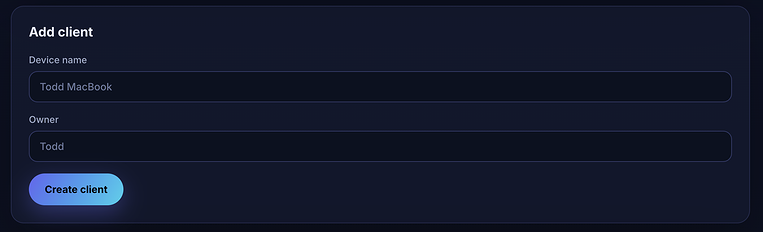
The client interface is quite useful when I need to add a new client, but that's pretty rare so I don't actually visit this interface all that often! When I started wanting more sophisticated monitoring, I came up with a different solution, but that will be in a later post!
As for the technologies, the interface is a simple React app and there is a Go service handling the backend. I used Go for most non-frontend things in this project as it is my personal language of choice! The data that is reported comes from Hawk (named for the blue-banded hawk that Beldin always transforms into as he flies around usually telling people about things).
Why Hawk runs on the individual machines
Hawk is a small Go agent that reports metrics about the health of each node. So Aldur is running as a service on Belgarath, but it still also has Hawk installed to provide the important metrics that Aldur reads. Each node also has a small job that runs every couple minutes to look for updates to the codebase and updates itself in place if there are updates! That's enabled me to deploy lots of changes to various services (and add a lot of new services) even as I've been in China.
In addition, each node has ZeroTier on them so I can SSH in even without the VPN. Luckily, ZeroTier seems to work fine here in China.
What else appeared in the first few days
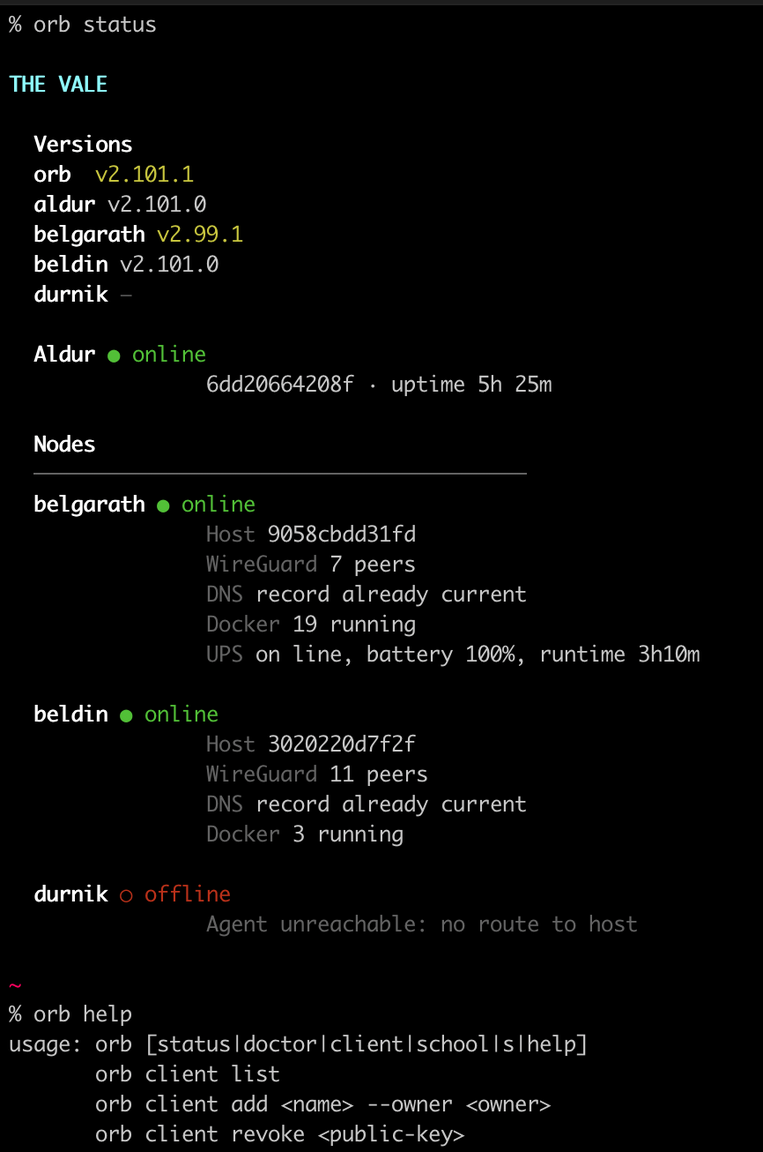
Those early days of setting everything up led me to wanting a few things in place. I already mentioned the deployment automation and some basic monitoring in Aldur, but I also decided to use Cloudflare DNS, setting up things on the nodes to automatically update the IP in Cloudflare if my home IP changes. I also love using CLI tools, so the orb was born (orb is a magic stone in the Belgarath series)! With the orb I can manage VPN clients and see the status of all my nodes.
With the deployment automation I started to see how there might be uses beyond just the VPN! I started to think I might be able to have other useful services, and in later posts we'll see what came of it!
Why build it yourself?
I really wanted this to act and feel the way I wanted, not just be some out-of-the-box tool. I wanted complete control. I did use existing, well-known things for the important parts: WireGuard, docker, Cloudflare DNS, ZeroTier. Those items all have security implications and NEEDED to work reliably while I'm gone! Aldur and other things that came out of it? So what if they break, they don't actually affect the VPN setup itself, at least in theory! In reality there are things I can do with them that affect the actual VPN, in fact I have broken it! Luckily ZeroTier allowed me to save it. Also, none of the services are publicly available, they are all only available when connected to the VPN.
I actually was starting to have a lot of fun with this project! I was very happy I didn't just go with an out-of-the-box prebuilt solution that I just plug and play. Looking back I'm still really happy I didn't do that, because I've been able to do so much more with this setup!
At this point in the project though I was starting to think more about reliability, and keeping things running even if the lights at the house turn off, and making sure things can all recover if disaster happens! We'll talk more about that in the next post...